Handling
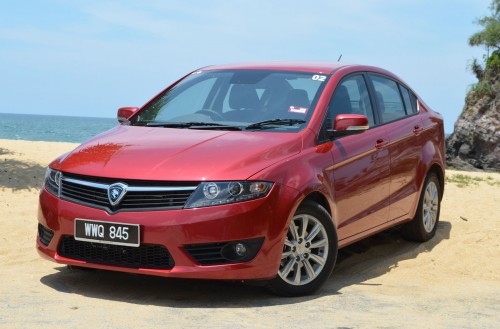
Much of the work Proton did was concentrated on improving the 2012 Proton Inspira's ride-and-handling. Even so, Mitsubishi limited the scope of changes: Proton was allowed to choose the tyre supplier (tyre size still 205/60 R16), use different shock absorbers, increase the size of the front/rear stabiliser bars, and tune the stabiliser bar and damper settings. The end result, Proton says, is a car that rolls less through corners and is more predictable at the limit compared with the Mitsubishi Lancer. On the move, the 2012 Proton Inspira is indeed less twitchy, containing body roll well, gripping on strongly and feeling very composed even when pushed hard. The steering is accurate though short on feedback and heft. While not as sporty to handle as the Proton Waja, the car it replaces, the 2012 Proton Inspira provides a better balance between handling prowess and ride comfort.
Comfort
The ride comfort is excellent, as road irregularities and undulating surfaces are nicely isolated. Cabin refinement is much better than any Proton's, but still some way short of a Toyota's, with engine drone at higher revs the biggest issue. The carried-over interior, dominated by a simple dash design, offers good ergonomics with controls and instrumentation that are intuitively positioned, easy-to-use and plain-in-sight. The seats are supportive, while the driver's seat adjusts for height. The steering, however, does not adjust for reach, which could pose a problem for certain drivers.
Quality + Reliability
Proton claims to have found better methods of manufacturing the interior panels, and that the 2012 Proton Inspira is equipped with a higher-quality interior than the Mitsubishi Lancer as a result. While we cannot be certain of that, the Proton Inspira is much better-built inside than any Proton is, and that will probably remain true for years to come. Quality plastics are used for high-contact areas, the fit-and-finish are completed to Mitsubishi standards, and the switchgear feels tactile to operate. What's not to like? The engines and transmissions have been proven reliable in the Lancer, and should remain so in the 2012 Proton Inspira.
Performance
Carried over unchanged from Mitsubishi, the 150 hp, 197 Nm 2.0-litre engine offers a strong on-road performance that never leaves you wishing for more power. Likewise, the 140 hp, 177 Nm 1.8-litre engine churns out enough oomph for your daily overtaking and highway cruising. Both engines prove willing to rev, hitting their peak power at 6000 rpm and peak torque at 4250 rpm. However, the 1.8-litre's engine note becomes especially loud and unpleasant at high revs—a situation made worse by the CVT. Keen drivers will find the CVT's six virtual ratios very handy, though those yearning for mechanical interaction will find pleasure in the five-speed manual gearbox (only with the 1.8-litre), which features a light clutch and feels precise to shift.
Roominess
Like in the Mitsubishi Lancer, the 2012 Proton Inspira is never lacking in space whether up front, at the back or in the boot. The driver and front passenger have plenty of room at their disposal, along with excellent support from the front seats. Those behind should not have too much to complain about, either, with no lack of leg- or head-room. Shoulder room is compromised with three passengers at the back, and the rear seating bench is not as comfortable as the front seats—though both remain true for rivals. The 400-litre boot can be expanded using the 60:40 split-fold rear seatbacks if required.
Running Costs
The 1.8 manual, 1.8 CVT and 2.0 CVT variants return fuel economy of 15.9 km/litre, 16.1 km/litre and 15.9 km/litre, respectively. All figures are highly impressive for a mid-size car, except that these figures, supplied by Proton, are only achievable when travelling at a constant speed of 90 km/h; frequent stop-start driving, common in an urban environment, would be much less economical. Car maintenance and servicing costs should be affordable, even in the longer term considering the car's proven reliability. Despite the Proton badge, the Inspira should hold on to its value relatively well compared with other Proton models. One would expect the trusted Mitsubishi underpinnings rather than the less desirable Proton reputation to dictate the Inspira's value in the resale market; only time will tell, however.
Value for Money
Born out of a technical agreement with Mitsubishi, the 2012 Proton Inspira is almost exactly the same as the Mitsubishi Lancer, except for some visual differentiation and suspension tweaking. The fact is that, with such a good base to work upon, Proton simply cannot go wrong with the Inspira, which exhibits traits like good looks, excellent ride-and-handling, and refinement and quality that are years ahead on any Proton. The 2012 Proton Inspira is easily the best local model to date, and, when you consider the value-for-money proposition, it is clearly the best car in the sub-RM 100K segment.
Equipment
Standard items include 16" alloy wheels, front fog lamps, “Welcome Home” and “Coming Home” light system, auto-off lights, keyless entry, power-adjustable side mirrors, reverse sensors, trunk lid remote release, leather steering wheel with audio controls, and Arkamys audio system with CD-player, MP3-compatibility and Bluetooth-connectivity. Safety features comprise dual front SRS airbags, front seatbelt pretensioners, ISOFIX points, and ABS with EBD. The Premium variant adds on a body kit complete with rear spoiler, paddle shifters, automatic headlights, automatic wipers, automatic climate control, leather upholstery, GPS navigation system, and auto cruise function controllable via steering wheel switches.
Environment
Proton has not supplied figures for the Inspira, but Mitsubishi has listed the fuel economy and carbon emissions of comparable Lancer variants: the 1.8 manual variant emits 183 grams/km and consumes 13.0 km/litre; the 1.8 CVT variant with 188 grams/km and 12.7 km/litre; and the 2.0 CVT variant with 196 grams/km and 12.2 km/litre. These figures are about average in the mid-size sedan segment. With no changes to the powertrain, it is fair to assume the same set of data for the 2012 Proton Inspira.


 The 2012 Volkswagen CC is essentially the alter ego of the VW Passat; while they're both sedans, the CC takes a path that's more daring in design and packaging—albeit at the expense of some practicality. To many, that's just fine, and the CC can be misjudged as a more expensive, more premium car that it is.
Design-wise, the CC takes after the Mercedes-Benz CLS with its stunning, coupe-like silhouette, frameless windows, and long, flowing design—plus a rear deck that tucks down instead of rising upward. The interior is a little different in layout than most sedans—it's a four-passenger sedan, with two individual seats in back, and the dash and doors are a little more lavishly trimmed than the typical mid-size sedan, with details like contrast stitching, contrast-color themes for the upholstery. New for 2012, CC models get a new analog clock above the radio.
The look implies that the 2012 CC is sportier than the Passat, though that's not altogether true. Straight-line acceleration is good from the 200-horsepower, 2.0-liter turbocharged four that's offered on most of the lineup; it's exceptionally smooth, and makes its peak torque of 207 pound-feet without revving high. What's more, it pairs really well with VW's excellent DSG automatic (the manual is also a good choice). A top VR6 4Motion Executive model steps up to a 3.6-liter VR6 engine and 4Motion all-wheel-drive guise, but altogether this combination gives the CC a noticeably heavier, but not altogether much quicker, personality—so we much prefer the four. Across the lineup, the CC handles well, but with its overly light steering and rather soft suspension calibration, it's clear that comfort is the priority over all-out performance.
Four-cylinder models—in addition to being relatively responsive and fuel-efficient—ride quite well, and across the model line the lavish interior trims feel luxury-car caliber. VW seems to have done well with the CC's frameless-window design, as the cabin feels tight and serene, with little road or wind noise.
Depending on what you're seeking in a sedan, the CC's odd but stylish seating arrangement could be a deal-breaker, or it could leave you more intrigued. The somewhat cramped backseat is only designed for two, and with limited headroom it's abundantly clear that the 2012 Volkswagen CC is a vehicle that was designed for form over function. In front, the seat position is simply a bit odd, with a scooped-up feeling that can also make headroom quite limited. Occupant safety looks strong for the CC, though, with IIHS Top Safety Pick status.
Six different trims of the CC are offered for 2012, including a sporty 2.0 R Line model that adds thin-spoke Mallory alloys, lower-body skirts, darkened taillights, and reflector-lens fog lights. All the models come very well equipped, with the base Sport including heated power front seats, a touch-screen sound system with HD Radio, Bluetooth hands-free, iPod connectivity, and 17-inch alloy wheels. For 2012, Lux Plus, Lux Limited, and 4Motion Executive models get new walnut inserts. An excellent Dynaudio sound system remains offered only on the top Executive VR6.
The 2012 Volkswagen CC ranks 9 out of 19 Upscale Midsize Cars. This ranking is based on our analysis of 21 published reviews and test drives of the Volkswagen CC, and our analysis of reliability and safety data.
The 2012 Volkswagen CC sacrifices function for style with its four-door coupe design and seating for four, but reviewers agree its looks inside and out help it stand out from the pack.
Though you may see more Jettas and Passats on the road, the 2012 Volkswagen CC is a car you should consider if you value style over practicality.
The Volkswagen CC is a good choice for drivers who want four doors, but rarely seat three in the back. Because it only seats four, it may not be the best family sedan. But reviewers say the compromise is worth it, and frequently compare its looks to the Mercedes-Benz CLS-Class.
The 2012 Volkswagen CC’s base turbo four-cylinder engine is well-liked by test drivers, who often say that the powerful V6 option isn’t worth the extra money. All-wheel drive is available, but you’ll pay more than $10,000 for it, since it comes standard only on the top-of-the-line six-cylinder model. If you want all-wheel drive and a four-cylinder engine on the CC, you’re out of luck.
Overall, reviewers think the 2012 CC’s lower trim levels are a good value for the money, with their class-competitive turbo four-cylinder engine, good fuel economy, smooth transmission and upscale interior. But most think the pricey V6 trim isn’t worth the extra dough. Other cars in this class offer more powerful V6 engines for less money.
The 2012 Volkswagen CC is essentially the alter ego of the VW Passat; while they're both sedans, the CC takes a path that's more daring in design and packaging—albeit at the expense of some practicality. To many, that's just fine, and the CC can be misjudged as a more expensive, more premium car that it is.
Design-wise, the CC takes after the Mercedes-Benz CLS with its stunning, coupe-like silhouette, frameless windows, and long, flowing design—plus a rear deck that tucks down instead of rising upward. The interior is a little different in layout than most sedans—it's a four-passenger sedan, with two individual seats in back, and the dash and doors are a little more lavishly trimmed than the typical mid-size sedan, with details like contrast stitching, contrast-color themes for the upholstery. New for 2012, CC models get a new analog clock above the radio.
The look implies that the 2012 CC is sportier than the Passat, though that's not altogether true. Straight-line acceleration is good from the 200-horsepower, 2.0-liter turbocharged four that's offered on most of the lineup; it's exceptionally smooth, and makes its peak torque of 207 pound-feet without revving high. What's more, it pairs really well with VW's excellent DSG automatic (the manual is also a good choice). A top VR6 4Motion Executive model steps up to a 3.6-liter VR6 engine and 4Motion all-wheel-drive guise, but altogether this combination gives the CC a noticeably heavier, but not altogether much quicker, personality—so we much prefer the four. Across the lineup, the CC handles well, but with its overly light steering and rather soft suspension calibration, it's clear that comfort is the priority over all-out performance.
Four-cylinder models—in addition to being relatively responsive and fuel-efficient—ride quite well, and across the model line the lavish interior trims feel luxury-car caliber. VW seems to have done well with the CC's frameless-window design, as the cabin feels tight and serene, with little road or wind noise.
Depending on what you're seeking in a sedan, the CC's odd but stylish seating arrangement could be a deal-breaker, or it could leave you more intrigued. The somewhat cramped backseat is only designed for two, and with limited headroom it's abundantly clear that the 2012 Volkswagen CC is a vehicle that was designed for form over function. In front, the seat position is simply a bit odd, with a scooped-up feeling that can also make headroom quite limited. Occupant safety looks strong for the CC, though, with IIHS Top Safety Pick status.
Six different trims of the CC are offered for 2012, including a sporty 2.0 R Line model that adds thin-spoke Mallory alloys, lower-body skirts, darkened taillights, and reflector-lens fog lights. All the models come very well equipped, with the base Sport including heated power front seats, a touch-screen sound system with HD Radio, Bluetooth hands-free, iPod connectivity, and 17-inch alloy wheels. For 2012, Lux Plus, Lux Limited, and 4Motion Executive models get new walnut inserts. An excellent Dynaudio sound system remains offered only on the top Executive VR6.
The 2012 Volkswagen CC ranks 9 out of 19 Upscale Midsize Cars. This ranking is based on our analysis of 21 published reviews and test drives of the Volkswagen CC, and our analysis of reliability and safety data.
The 2012 Volkswagen CC sacrifices function for style with its four-door coupe design and seating for four, but reviewers agree its looks inside and out help it stand out from the pack.
Though you may see more Jettas and Passats on the road, the 2012 Volkswagen CC is a car you should consider if you value style over practicality.
The Volkswagen CC is a good choice for drivers who want four doors, but rarely seat three in the back. Because it only seats four, it may not be the best family sedan. But reviewers say the compromise is worth it, and frequently compare its looks to the Mercedes-Benz CLS-Class.
The 2012 Volkswagen CC’s base turbo four-cylinder engine is well-liked by test drivers, who often say that the powerful V6 option isn’t worth the extra money. All-wheel drive is available, but you’ll pay more than $10,000 for it, since it comes standard only on the top-of-the-line six-cylinder model. If you want all-wheel drive and a four-cylinder engine on the CC, you’re out of luck.
Overall, reviewers think the 2012 CC’s lower trim levels are a good value for the money, with their class-competitive turbo four-cylinder engine, good fuel economy, smooth transmission and upscale interior. But most think the pricey V6 trim isn’t worth the extra dough. Other cars in this class offer more powerful V6 engines for less money.

 Nissans have a strong reputation for reliability and durability, coupled with low running costs… attributes which customers are always looking for. And for those who don’t need the latest model in their garage or porch, the Sentra remains a practical car to buy.
Over the years, ETCM has kept adding enhancements to the Sentra to freshen its looks periodically. At different times, the enhancements have made the car look more elegant or more sporty, appealing to different segments of the market. In fact, ETCM’s continued development of the Sentra even prompted Nissan to allow it to export the model to Indonesia for sale there. From Dato’ Dr Ang’s statements that the Sentra will be around for some years to come, it sounds like it will catch up with the other long-running model, the Sunny, which was available in this market for 13 years.
This time round, with its tie-up with IMPUL Motor Racing Development of Japan, ETCM has created an IMPUL version for the Sentra. This would be the fourth model that has received the Impul upgrade, the others being the Latio, Sylphy and Grand Livina.
For the IMPUL Sentra, the following items have been added: aerokit (including rear spoiler), sports suspension system which lowers the ride height by about 25 mm, IMPUL’s Blast II exhaust muffler, and bronze-finished 16-inch IMPUL FS-16 alloy wheels (imported from Japan) which replace the standard 14-inch wheels.
The following are the prices (inclusive of roadtax/insurance) for IMPUL versions of the different Sentra variants:
Sentra 1.6L MT Comfort - RM94,500
Sentra 1.6L MT Luxury - RM98,500
Sentra 1.6L AT Comfort - RM98,600
Sentra 1.6L AT Luxury - RM102,600
Nissans have a strong reputation for reliability and durability, coupled with low running costs… attributes which customers are always looking for. And for those who don’t need the latest model in their garage or porch, the Sentra remains a practical car to buy.
Over the years, ETCM has kept adding enhancements to the Sentra to freshen its looks periodically. At different times, the enhancements have made the car look more elegant or more sporty, appealing to different segments of the market. In fact, ETCM’s continued development of the Sentra even prompted Nissan to allow it to export the model to Indonesia for sale there. From Dato’ Dr Ang’s statements that the Sentra will be around for some years to come, it sounds like it will catch up with the other long-running model, the Sunny, which was available in this market for 13 years.
This time round, with its tie-up with IMPUL Motor Racing Development of Japan, ETCM has created an IMPUL version for the Sentra. This would be the fourth model that has received the Impul upgrade, the others being the Latio, Sylphy and Grand Livina.
For the IMPUL Sentra, the following items have been added: aerokit (including rear spoiler), sports suspension system which lowers the ride height by about 25 mm, IMPUL’s Blast II exhaust muffler, and bronze-finished 16-inch IMPUL FS-16 alloy wheels (imported from Japan) which replace the standard 14-inch wheels.
The following are the prices (inclusive of roadtax/insurance) for IMPUL versions of the different Sentra variants:
Sentra 1.6L MT Comfort - RM94,500
Sentra 1.6L MT Luxury - RM98,500
Sentra 1.6L AT Comfort - RM98,600
Sentra 1.6L AT Luxury - RM102,600